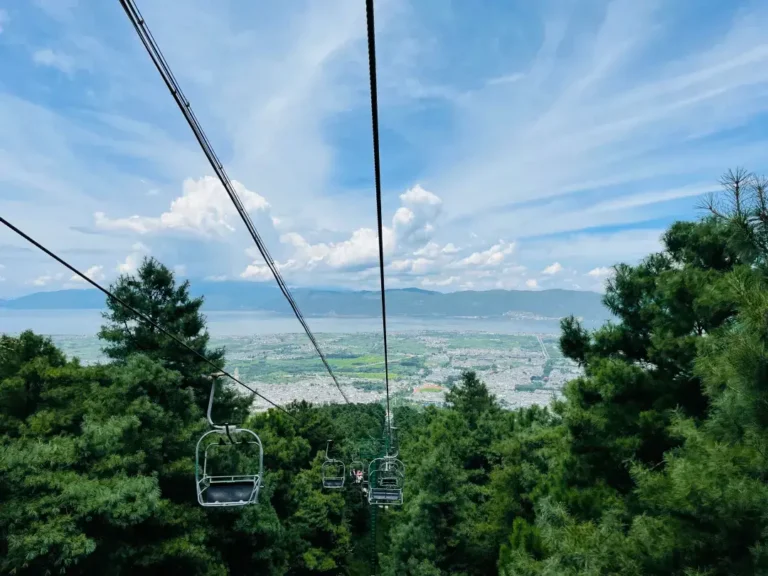
Erhai Lake, Dali: The Loop, Villages & Where the Sun Actually Sets
It’s a November evening, and I’m standing on the sea street in Shuanglang, looking out over Erhai Lake. The water stops me first — a long, flat sheet of blue. Across it, Cangshan rises like a dark green wall, the sun sinking into it an inch at a time while the sky burns from orange to violet. A few black-headed gulls skim the surface, wingtips almost touching the ripples.
Erhai Lake isn’t a sea. People in Yunnan call big lakes “hai,” but this one has a sea’s scale — 129 km of shoreline, about 1,972 meters (6,470 ft) above sea level, stretched into a 40-plus-km crescent shaped like a human ear. (“Er” comes from that shape, though some linguists trace it to an older transliteration.) I checked this guide against Dali municipal notices, Erhai Lake Administration data, and three months of English traveller reports (November 2026). Because looping this lake comes down to one decision: which shore you’re standing on.
Where is Erhai Lake? Erhai Lake, Dali, China — a long basin in western Yunnan, in the country’s southwest. You’ll see a few spellings: “lake Erhai” in older English guides, “lac Erhai” in French ones. It’s all the same water. Dali’s Erhai Lake is Yunnan’s second-biggest highland lake. The Three Pagodas rise just north of the Old Town, and Cangshan’s Jade Belt Cloud Road threads the ridge above — both worth a separate day (see our Cangshan Mountain guide).
The Erhai Lake Loop: West Shore vs East Shore
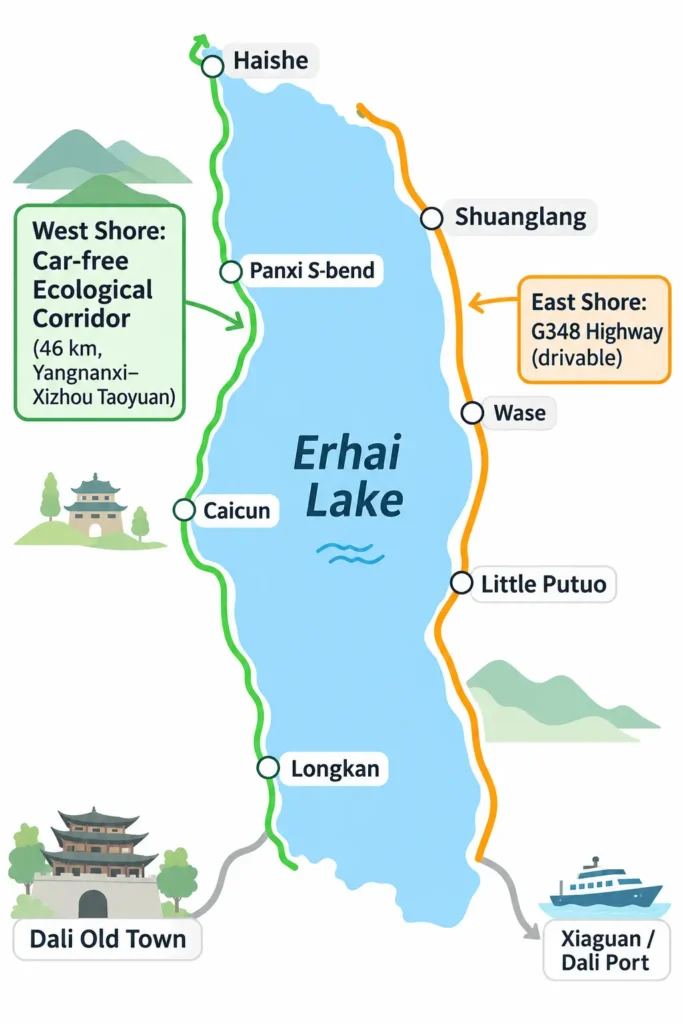
One thing to get straight before anything else: there are two completely different roads around this lake, and they follow different rules.
The west shore — the Cangshan side — hugs the water with the Erhai Lake Ecological Corridor. The full corridor runs 129 km around the lake, but the stretch everyone means is the west-shore section: 46 km from Yangnanxi to Taoyuan in Xizhou. It’s open only to walkers, bicycles, and official shared e-bikes. Cars, e-bikes, scooters, and balance boards are all banned — the only motorized thing allowed is a licensed sightseeing shuttle. This is the line where you’re actually touching the water.
The east shore — across the lake, against the eastern hills — is the G348 coastal road, an ordinary highway. Cars and rented e-bikes run here freely, but the road often sits a bit back from the water. Not quite zero distance.
Don’t mix the two up. This is exactly why so many foreign visitors arrive and feel the guidebooks lied: they rent an e-bike expecting to ride right along the water for a full loop, and get turned away at the west-shore gate.
Where to Start
Most people start at Caicun Village or Longkan pier. (The official 46-km stretch begins at Yangnanxi, further south toward Xiaguan.) Both piers sit just east of Dali Ancient Town (the Old Town), a 15–20 minute taxi ride away. Longkan to Caicun is only one stop — about 3–4 km — and this is where the metasequoia trees and the old ferry landing are. In a hurry, take the shuttle. Otherwise, ride it; this short stretch is worth slowing down for.
For a half-day ride: Caicun north to Haishe Park is about 24 km, flat and threading through villages — the most comfortable chunk for most people. For a full loop, you need the east-shore road: driving or riding the whole thing runs 128–130 km (the same thing as the 129 km shoreline, just said two ways).
Cycling, E-bike, Cruise, or a Hired Car?
Ride, cruise, or hire? Depends on what you want.
| Option | Price | Best for |
|---|---|---|
| Bicycle | ¥20–50 / day (USD 3–7) | Slow riders who want to stop anywhere; the west-shore corridor pick |
| E-bike | ¥50–100 / day (USD 7–14); scenic-area shops ¥120–150 | Less fit riders going far; mostly on the east-shore road, or village lanes outside the corridor |
| Shared bike / e-bike | ¥6–8 / hour (USD 1); assisted e-bike ¥15–20 / hour (USD 2–3) | Short hops; billed by the half-hour, no daily cap |
| Corridor shuttle | ¥10 / stop (USD 1.5); ¥40 one-way (USD 6); ¥60 round trip (USD 9) | Non-riders avoiding the sun; west shore only, flag it down |
| Self-drive car | ¥150–400 / day (USD 21–57) | A full loop in one day — but this is guidebook range; confirm on the ground |
| Car with driver | ¥300–500 / day (USD 43–71) | Anyone who doesn’t know the roads and wants it easy |
Two rules before you commit.
A shop rental has to go back to the same shop, so a one-way loop — rent on the west shore, drop on the east — doesn’t work. Shared bikes dock inside an electronic fence. Deposits usually run ¥200–800 (USD 29–114), and some small shops only take cash or WeChat, so ask before you set off.
An e-bike rented in the Old Town can’t enter the Ecological Corridor. This one trips people constantly: you pay once in the Old Town, ride to the west-shore gate, get turned away, then pay again on the spot for a bicycle just to ride by the water. Two rentals, one ride.
The cruise is another path — slower, and it loops around. Skip it if you only want to ride. But if you want the lake-from-the-middle view without the legwork, it’s actually decent value. Three ticket types:
- Long route (one-way): departs Dali Port at 09:30, stops at Nanzhao Folk Island for about 50 minutes (Bai three-course tea and dance show included), reaches Shuanglang at 12:20 — roughly 3 hours. ¥130 online / ¥142 at the window (USD 19–20). The reverse run leaves Shuanglang at 15:00.
- Short round-trip: about 1 hour 20 minutes, no island stop, from ¥104 (USD 15). Good only if you want an hour on the water. Schedules vary by platform — check the day-of notice.
- Theme boat: ¥168 (USD 24), the Fenghuaxueyue.
Heads up: the long route ends in Shuanglang, and getting back is on you. A direct bus from Shuanglang to the Old Town is ¥40 one-way (USD 6); a hired car runs ¥150–200 (USD 21–29); or you stay the night. Dali Port sits far from the Old Town (about 17 km): a taxi is ¥40–80 (USD 6–11), 30–50 minutes, or take the Erhai loop bus direct shuttle at ¥15 (USD 2).

The Villages Worth Stopping For
Wondering about things to do in Erhai Lake? The main stops string along the shore, and a few villages are actually worth getting off the bike for.
On the west shore, just north of the lakeside Erhai Park, Caicun Village is where most people start — the pier gets busy at sunrise. North of it is Xizhou: I’ll keep this short. The Bai villages and their courtyard houses, the Xizhou baba (a flaky flatbread), and the old Bai tie-dye workshops deserve a half-day on their own, but if you’re looping, just duck in to see the rice fields and the old street. Save the deep dive for our things to do in Dali guide.
Shuanglang Ancient Town: Worth a Night, Not a Day Trip
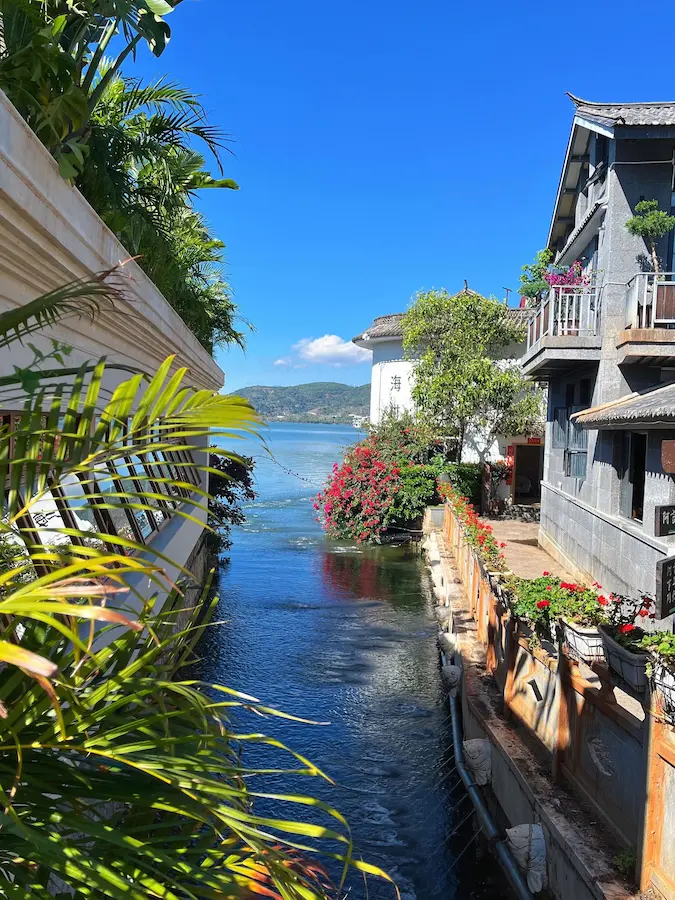
Then the big one: Shuanglang Ancient Town. Let me be straight — it’s worth one night, not a dedicated day trip. Shuanglang is the most concentrated stretch of waterfront buildings on the whole lake. Everywhere else, a “lake view” room still has a road or a corridor between you and the water. Only here do the shops and lanes sit right against Erhai Lake.
It’s free, open 24 hours, and the G348 coastal road passes straight through town — so the loop route still works here. But cars can’t enter the old lanes. Since September 2025, the ethnic-culture street, Shuanglang pier, Hai Street, and Yuji Island Street are pedestrian-only around the clock (no motor vehicles, no e-bikes), with parking at the north or south gate at ¥10 / hour (USD 1.5), capped at ¥40 (USD 6).
One more thing: from November 10 to December 31, 2026, the whole town is in a road-environment cleanup — clearing rubbish and ditches along the G348 section. Not a shutdown, but expect barriers, a construction feel, and possible half-lane closures.
The real problem is daytime. The main street takes 30 minutes to walk, and it’s loud and overpriced — a latte from ¥48 (USD 7), three pieces of street fruit ¥46 (USD 6.6), and much of the waterfront is fenced off by cafes and guesthouses, leaving only the wetland park and the pier as free water access. So the verdict holds: stay the night, when the day-trippers clear out and Hai Street goes quiet. That’s when it’s worth it. For real quiet, head toward Wase, Wenbi Village, and Haidong on the east shore.
Further east, Wase and the little island near it mark the east shore. Little Putuo isn’t a mid-lake island — it’s a tiny islet just twenty-some meters off the shore at Haiyin Village, with one small temple on it. In winter, black-headed gulls gather around. Stop, grab a gull photo, move on.

Where the Sun Actually Sets
This is where people stand on the wrong shore.
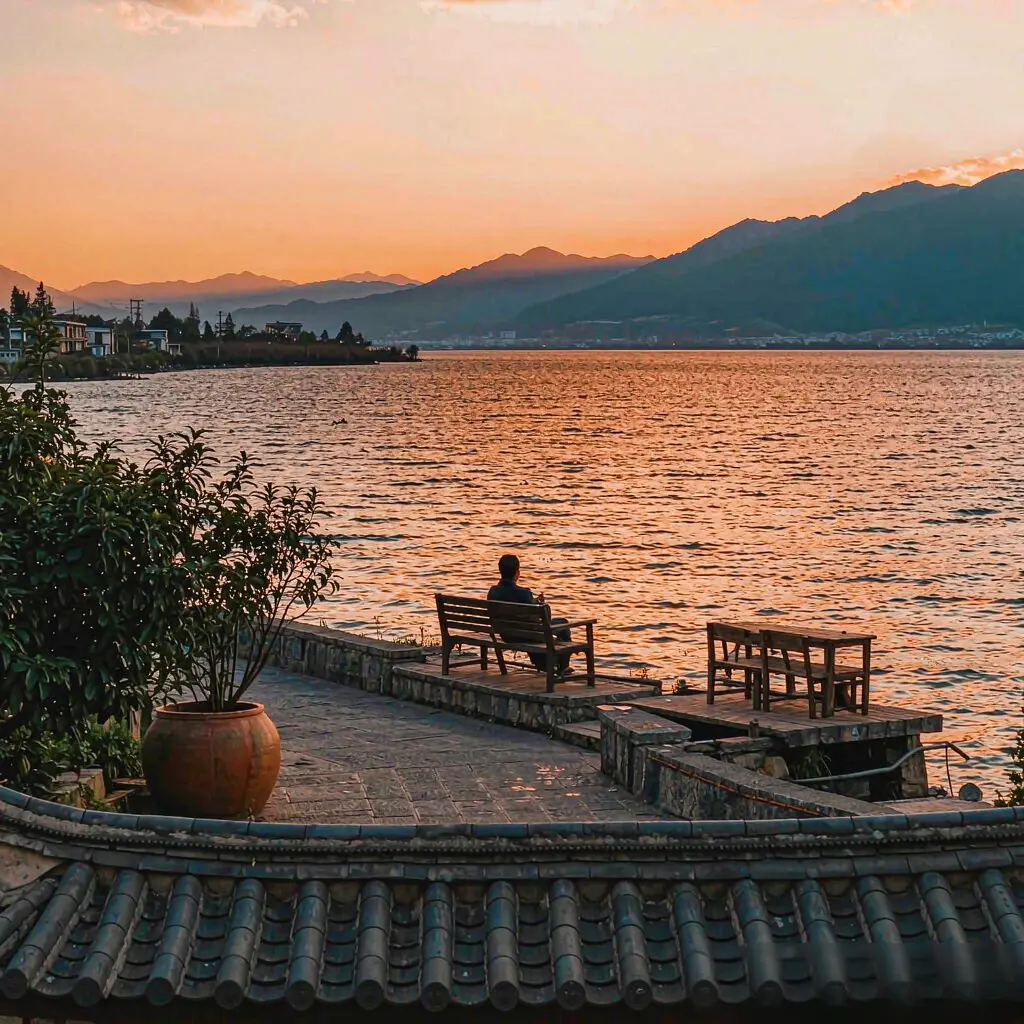
Erhai Lake runs north-south, and Cangshan sits to the west. So the shore that actually gets the sun sinking into the lake is the east shore: Shuanglang’s Hai Street, Yuji Island, and the pier square, plus Wase pier, Little Putuo, Wenbi Village, and Ideabang (Ideal Land). All of them face west — the sun drops into the gap between the Cangshan silhouette and the water.
The west shore — Caicun, Longkan, the Panxi S-bend — is for sunrise. Those piers face east; in the evening you only get the sun sliding behind Cangshan with a glow on the sky, not the round sun touching water. If you want a proper sunset, don’t stay west. Haishe Park is even trickier: under the 2026 reservation system, it only opens in the morning (about 200 people a day, adjusted by season), and it’s closed in the afternoon — so no sunset there. Check the booking page before you go.
Rough timing: in November the sun sets around 18:25–18:35, slightly west-southwest; in late June around 20:08, west-northwest. Check a weather app on the day.
Getting to Erhai Lake & Which Shore to Stay On
Keep this part short — the details live in the dedicated guides.
How far is Erhai Lake from Dali? From the Old Town’s Erhai Gate to Caicun pier (the easiest entry) is about 5.4–7 km, a ¥10–18 taxi (USD 1.5–2.6), 15–20 minutes. To Longkan pier, about 6–7 km, ¥15–20 (USD 2–3).
Which shore to sleep on? The west shore is close to the Old Town — lively, full of cafes and guesthouses, good if you like stepping out for a wander. On the east shore, only Shuanglang sits truly on the water, and it’s the busiest and priciest; for quiet, pick Wase, Wenbi Village, or Haidong. For specific hotels, see our Dali travel guide.
For getting around beyond the lake, see our getting around Yunnan guide. For the wider province, start with things to do in Yunnan, and if you’re still picking dates, our best time to visit Yunnan guide.
Mistakes to Avoid Before You Loop the Lake
Six things to write down before you set off.
- Don’t trust “60 km east, 70 km west” split numbers. Officially there are only two: the shoreline (which equals one full loop) at 129 km, and the west-shore corridor at 46 km. Everything else — like “Caicun to Haishe is 24 km” — is traveller-measured, not official.
- The west shore can’t see the sun set into the lake; the east shore can’t see sunrise. Wrong shore is the most common and most deflating mistake. Decide which one you’re after before you leave.
- Haishe Park can’t be your sunset spot. It opens mornings only.
- An Old Town e-bike can’t enter the Ecological Corridor. Rent a bicycle at the gate if you want to ride the water’s edge — don’t pay twice. In 2026, Dali is cracking down on rental e-bikes: unlicensed, unregistered, speed-unlocked, and no-helmet rides are all being fined, the “white-plate red-letter” over-spec bikes have been scrapped, and under-16s can’t ride.
- Be careful hiring a car. One traveller reported renting a “Porsche” for ¥128 (USD 18) and getting a wrecked car; another was pushed into buying expensive coverage and, after refusing, got hit with a ¥2,500 (USD 357) damage claim on return. Inspect the car, save the rental shop’s number, and don’t chase the lowest price.
- Shuanglang is under renovation in November–December, and its waterfront is heavily fenced. Daytime is loud and pricey, and the jade “lucky draw” that ends in a ¥299 (USD 43) “discount” is a classic setup. If you stay, don’t force a daytime stroll.
Erhai Lake FAQs & a One-Day Cheat Sheet
Quick answers to the questions people actually ask about Erhai Lake in Dali.
- Is Erhai Lake man-made? No. Around 3.5 million years ago, the Red River fault lifted the west side into Cangshan and dropped the east into a basin — a fault-block lake, naturally formed.
- Is Erhai Lake polluted? It went through a serious pollution crisis in the 1990s, but a long cleanup since has pushed the water back to “excellent” quality for three years running.
- Can you swim in Erhai Lake? No. It’s Dali’s drinking-water source, and swimming is banned across the whole lake. The only legal swimming water is the Xi’er River stretch in Xiaguan, west of Xingsheng Bridge.
- Circumference, altitude, weather? About 129 km of shoreline, about 1,972 meters (6,470 ft) up. Spring and autumn are mildest (March–May, September–October); winter (November–March) is gull season, and the only time you get “snow + gulls” in one frame.
- Main attractions? The Ecological Corridor, the Panxi S-bend, Shuanglang, Wase, Little Putuo, and the east-shore sunset.
- How long? Half a day for the west-shore ride (Caicun to Haishe, about 24 km); a full day for the whole loop.
One-day cheat sheet (screenshot it)
- Morning: taxi to Caicun or Longkan pier for sunrise. (Summer sunrise is around 6:30; the shuttle only starts around 8:00, so walk the shore first.)
- Mid-morning: ride the west-shore corridor. Longkan to Caicun is only 3–4 km, with the metasequoia and the old ferry — ride it.
- Lunch: Bai food near the Panxi S-bend.
- Afternoon: cross to the east shore, wander Shuanglang’s Hai Street and Yuji Island.
- Evening: watch the sunset from Shuanglang pier or Yuji Island (around 18:30 in November).
- Night: either stay in Shuanglang, or take the ¥40 (USD 6) direct bus back to the Old Town. Don’t force the full loop.
Dali is a place that asks you to slow down. The loop isn’t a task — it’s an excuse to put the phone down and listen to the wind over the water for a while. The rest is up to the weather.

Ke Ping — Founder, Yunnan Travel Tips
Certified China Travel Specialist · Certificate details
This guide can become your real trip. Instead of figuring out complicated logistics alone, let me and our team build your perfect Yunnan journey — from sunrise at Meili Snow Mountain to tea tasting in ancient Dali.
📋 Plan My Yunnan Trip